
I could try that. Any suggestions about temperature and duration?
I was going to sit the jar on the cold stirrer for 2 weeks.
I don't have any information to go on really other than one little tidbit which might be worth considering given the dramatic transformation in the aroma of oud wood when it is heated: one article I posted here a few months back about chemical analysis of wild and cultivated kinam had some comment about heating their extract to 150°C because at that temperature some of the odorless chromones found in the raw wood are chemically transformed to something that has a noticeable smell. I don't know if this just applies to kinam type sinensis.

i'm not sure what temperature agarwood resin starts to liquefy and bubble / flow but that would be another way to figure out the temperature if there is information on that. I am pretty sure it will be different for different species of wood
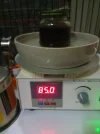
I'll opt for 30-40 minutes at 85°c and slow cool down to room temperature, then continue on the cold stirrer.
IMG_20260501_003926_6.webpIf i understand the bits and pieces that i found correctly: One could start such maceration at 85 for 30-60 minutes; let it cool down and keep it at roomtemp for 2-3 days; then strain and be done. More heat or longer exposure to heat would result in loss of topnotes. So i'll better stay on the safe side i guess..
I may try that 150 degree variant some day, but not with 200ml 😬
 
I would love to get some real data on rates of diffusion and things like that - based on my understanding I would expect that you would have to let that maceration sit for much longer, months as supposed to days. This from my experience watching saffron extract into sandalwood oil. I feel like it's kind of a comparable situation with very heavy high molecular weight slow to diffuse materials. Both the carrier and the plant matter being extracted here are "heavy" and slow to diffuse.
 
I would love to get some real data on rates of diffusion and things like that - based on my understanding I would expect that you would have to let that maceration sit for much longer, months as supposed to days. This from my experience watching saffron extract into sandalwood oil. I feel like it's kind of a comparable situation with very heavy high molecular weight slow to diffuse materials. Both the carrier and the plant matter being extracted here are "heavy" and slow to diffuse.
Yeah. Thats the downside of the internet, i think, that all sorts gets parroted and start a life of its own, while the original context got lost..

That said, i have noticed that maceration a fine powder on the stirrer is a lot faster than with just a daily shake. All particles remain floating, while otherwise they sink to the bottom and you pretty much only have diffusion going on from the top layer. Thats why i think 2 weeks on the stirrer should be sufficient. At the same time it would not surprise me if putting it on the shelf for 6 months would result in a totally different and much richer scent profile. Time is a powerful ingredient after all. Just because diffusion stops, doesn't mean that its done.
I think the mention of hot infusion plus a 2 day rest is from the context of doing hot infusion to save time, not to improve the scent profile.
However 85° is mentioned as a good temp for the incense powder to release its aroma, so perhaps that is valid for infusion as well, i dont know but i can try it.
In the end i have more questions than answers, same as with distillation where they say long and slow is better. But do you end up with a complete profile? I still dont know..
Just as an example, here i'm distilling
[Ouddict.com] MFH - Experiments & Materials
yet another funny recipe.
For over 2 days i saw just water condensing. Now suddenly i see particles on the inside of the condenser. Nothing changed, same slow rate. I could have given up already concluding that it was a rubbish idea. (Still might be 🙂)
I could have decided to increase the steamflow because nothing happened. You cant google this stuff. Just let it run, observe and try to understand/ learn..
 
IMG_20260507_182950_2.webp

By-product of an experiment.
I soaked:
Ground applewood, plum, apricot, pear, apple, cinnamon, lemongrass and 1ml of frankincense maydi for 4 days;
Then distilled it slooowly over jojoba until the waxes from the fruits began to show up;
Resulting in a nice barnyard open, followed by spices and green fruit,
that seem to become more red during drydown.

(In the photo a 'stopcork' of papertowel to remove a few drops of water..)

Currently contemplating* a tea (very honey assam tgfop + pinghe yesheng you zi hua) and pinebark distillation. Probably will do the teas first to collect hydrosol** and then use that to steam-distill the bark.

*Fancy word for trying to figure out the balance 🙂
** Yes, thats inspired by a recent @An Agarwood post - clever way to avoid cooked notes you would get when doing a co-distillation. Merci!
 
Last edited:
View attachment 54507
By-product of an experiment.
I soaked:
Ground applewood, plum, apricot, pear, apple, cinnamon, lemongrass and 1ml of frankincense maydi for 4 days;
Then distilled it slooowly over jojoba until the waxes from the fruits began to show up;
Resulting in a nice barnyard open, followed by spices and green fruit,
that seem to become more red during drydown.

(In the photo a 'stopcork' of papertowel to remove a few drops of water..)

Currently contemplating* a tea (very honey assam tgfop + pinghe yesheng you zi hua) and pinebark distillation. Probably will do the teas first to collect hydrosol** and then use that to steam-distill the bark.

*Fancy word for trying to figure out the balance 🙂
** Yes, thats inspired by a recent @An Agarwood post - clever way to avoid cooked notes you would get when doing a co-distillation. Merci!
this is very interesting. Love these experiments. I'm not sure I understand exactly what you did!

First - you soaked all of those materials in just 1 mL of frankincense oil? Sounds like it would form like a paste or dough. Or were they soaking in jojoba oil?

Were these dehydrated apricots, pears, plums?

When you say "distilled over jojoba" is this meaning that you were doing a water distillation with jojoba in the collecting flask?

Thank you!
No 🙂 i soaked all the ingredients in roughly 3L of water, including that 1ml frankincense. Fruits were dehydrated, they call it dried overhere, but its that sticky stuff when you try to cut them in pieces..
Then poured it al in the still (so hydrodistillation) and put jojoba in the receiver.
Made sure that the condensate drips straight in the middle and let it run @ 1 drip per 2 seconds until waxes started to appear.

I could have used amyris base-fraction oil instead of jojoba but found an empty bottle.
Good opportunity to try the hercolyn i recently bought to make liquid blends a bit more viscous/ swipable..
 
That is 100 ml previously infused jojoba +
100 ml fresh jojoba +
25 gr powder with only 'tram huong - incense powder' on the label 🤷
Oh i lied🙂
Twas 50 ml of prev infused oil, rest is correct..
Meanwhile i have filtered it with my brand new vacuumfiltration thing, works a charm. Then I dropped the glass funnel which died on impact. (Cant blame me for not supporting the global economy 😬)
Funny observation, straight after the filtration, trying the oil was meh. Let it sit in a half-filled jar for a few days and its full of aroma.
 
Last edited:
View attachment 53824
First fraction (and most likely the only one) done.

Faint hint of chocolate, orange, a hint of lemon and clove (i last-minute put some cloves on the orange peels). Cant say i can detect the sage, maybe it pops up after it matured for a while.
Revisited this and it changed so much! Chocolate, orange and the minty sage merged into a smooth and surprisingly well balanced scent. The clove has moved into the background. I imagine its kind of the binding element here, tying the 3 scents together. That might well be rubbish talk though. Next time i feel bored i'll try investigate if clove has such properties.
 
Currently contemplating* a tea (very honey assam tgfop + pinghe yesheng you zi hua) and pinebark distillation. Probably will do the teas first to collect hydrosol...
IMG_20260508_172045_1CS.webpStarted collecting the hydrosol. Collected some drips on my hand, while wet it's mostly an astringent scent. Left to dry, it turns into a floral-honey scent against a mild tea-ish backdrop. Quite a delicate scent. If i had this in the shape of an extract i would blend it with some Iceland moss (Guaiac would be another option) and be happy. But i don't so i won't 🙂
 
View attachment 54526Started collecting the hydrosol. Collected some drips on my hand, while wet it's mostly an astringent scent. Left to dry, it turns into a floral-honey scent against a mild tea-ish backdrop. Quite a delicate scent. If i had this in the shape of an extract i would blend it with some Iceland moss (Guaiac would be another option) and be happy. But i don't so i won't 🙂
Spent some zen time tearing up the pieces of bark yesterday, now slowly heating it all up.
[Ouddict.com] MFH - Experiments & MaterialsDid put some jojoba in the receiver as i don't expect much oil from the material. Ideally you would want to use an oil that is to be part of the fragrance, but could not think of anything that would not interfere.
 
Spent some zen time tearing up the pieces of bark yesterday, now slowly heating it all up.
View attachment 54576Did put some jojoba in the receiver as i don't expect much oil from the material. Ideally you would want to use an oil that is to be part of the fragrance, but could not think of anything that would not interfere.
Done.
Bark still smelling lovely after the 3 day run, makes one doubt if 3 were enough 😬
[Ouddict.com] MFH - Experiments & Materials
 
Done.
Bark still smelling lovely after the 3 day run, makes one doubt if 3 were enough 😬
View attachment 54621
Hard to describe the result as i'm not sure what exactly i'm smelling.
It's not quite your walk in a pine forest scent, but i can't really smell the original notes from the hydrosol either. It modified the scent of the bark into something softer without revealing itself (yet). The result is pleasant though, even if i could have used a bit less carrier oil maybe. Will let it sit for a while to see how it develops and, by the looks of it, there's some moisture to get rid of.
[Ouddict.com] MFH - Experiments & Materials
 
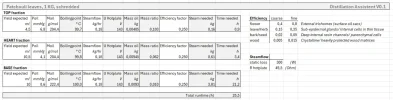
I've been playing with Excel to build a 'distillation model'. First it calculates the theoretical distillation time per fraction, based on average molecular weight and vapor pressure of the oil, the expected yield and the carrying capacity of the steam at a given flowrate. That's only valid if you would pour essential oil in the water to re-distill it. Rather useless, unless you want to split that oil in fractions, ofcourse.
So the formula needs to take into account how long it takes for the oil to diffuse from the botanical, which depends on the type of plant matrix and particle size. I can't do such complex math so I use a simple table with the average numbers for the 4 matrix types, either coarse or fine.
While i was at it, i calculated the net energy needed to produce a specific steamflow and translate it to the voltage setting for my hotplate, very convinient (it also made clear that I need to insulate the still because it showed I waste a lot of energy atm).
DA01.webpWether the whole thing is at all useful remains to be seen. Guess it's nice to be able to calculate an estimate of the distillation time, specially when working with unusual materials. Beyond that, nothing beats experience and the effort to get a feel for the stuff you want to work with.
 
Last edited:
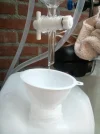
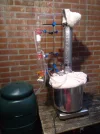
Arranged myself a proper extraction workplace instead of the kitchen floor. May sound silly but the pump had to sit outside as you don't want oil/ ethanol fumes indoors.
Replaced the pump with a closed water loop Venturi model* that is suitable for indoors. As bonus the vacuum is much more gentle, future topnotes will appreciate that.
IMG_20260522_211126_7.webp

Below the table a cheap freezer that has the coldtrap inside to recover the ethanol. Bit of a silly solution but then, who cares🙂

* Google: SHZ-D(III)
 
Last edited:
Top