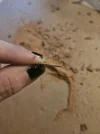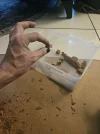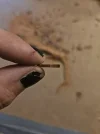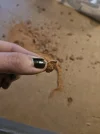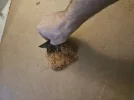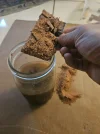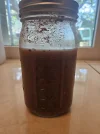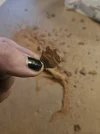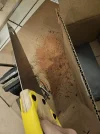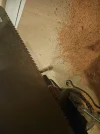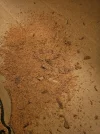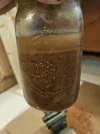
i sawed up another stick so we can better see whats goin on under the lid 🙂

the end nubs that i cant grip and cut get put back in the box. gonna keep em around for the slow burn and pics. if its penny width or less it goes into the jar.

while im sawing, i do twist off about midway through to break up the pieces further. the cross sections here are about as big as they get
 

Attachments

  • [Ouddict.com] Mysore Sandalwood Extraction (finished project))
    20240120_110415.webp
    71.7 KB · Views: 116
  • [Ouddict.com] Mysore Sandalwood Extraction (finished project))
    20240120_110430.webp
    187.1 KB · Views: 106
  • [Ouddict.com] Mysore Sandalwood Extraction (finished project))
    20240120_110449.webp
    90.8 KB · Views: 101
  • [Ouddict.com] Mysore Sandalwood Extraction (finished project))
    20240120_110505.webp
    83.6 KB · Views: 89
  • [Ouddict.com] Mysore Sandalwood Extraction (finished project))
    20240120_110657.webp
    222 KB · Views: 97
  • [Ouddict.com] Mysore Sandalwood Extraction (finished project))
    20240120_110716.webp
    147.3 KB · Views: 100
  • [Ouddict.com] Mysore Sandalwood Extraction (finished project))
    20240120_111008.webp
    105.6 KB · Views: 108
  • [Ouddict.com] Mysore Sandalwood Extraction (finished project))
    20240120_110402.webp
    94.1 KB · Views: 118
i need to get a big disc sander from harbor freight and put a real low grit on there and dust it down lol
I feel like I’m being a pain in the ass but if you ever have the chance you should really try a large, heavy weight mortar and pestle. ( you may already have and may have made the educated decision not to use one, so apologies for the assumptions).

It’s also the preferred method for the Japanese incense houses because there’s none of the extreme temperature associated with a saw blade. obviously, they are doing this on a different scale, but they have these large wooden pestles that are basically a log hooked up to some rotary mechanism like a piston, and they just pounds the heck out of it.

At some point, I aim to get a large round hardwood log (oak, walnut, etc), hollow it out halfway and shape a small log into a pestle.

For now I’m using this heavy brass mortar (used by the TCM docs in the bay area which got me looking for one).

This thing is amazingly effective, but it’s smaller than I’d like and i am not convinced the metal doesnt impart a little metallic aroma. The skirt and heavy brass pestle make this pretty easy to use and effective but i would love to have a heavy duty wood setup. Like those mochi pounding rigs they use for mochitsuki! Apologies if this sounds like I’m telling to tell you what to do and take it with a grain of salt - you’re the one actually with your hands on the stuff and you know best what is going to work for you… honestly i’m just kind of psyched for your project and sharing the limited experience in this area that i have
[Ouddict.com] Mysore Sandalwood Extraction (finished project))
 
I feel like I’m being a pain in the ass but if you ever have the chance you should really try a large, heavy weight mortar and pestle. ( you may already have and may have made the educated decision not to use one, so apologies for the assumptions).

It’s also the preferred method for the Japanese incense houses because there’s none of the extreme temperature associated with a saw blade. obviously, they are doing this on a different scale, but they have these large wooden pestles that are basically a log hooked up to some rotary mechanism like a piston, and they just pounds the heck out of it.

At some point, I aim to get a large round hardwood log (oak, walnut, etc), hollow it out halfway and shape a small log into a pestle.

For now I’m using this heavy brass mortar (used by the TCM docs in the bay area which got me looking for one).

This thing is amazingly effective, but it’s smaller than I’d like and i am not convinced the metal doesnt impart a little metallic aroma. The skirt and heavy brass pestle make this pretty easy to use and effective but i would love to have a heavy duty wood setup. Like those mochi pounding rigs they use for mochitsuki! Apologies if this sounds like I’m telling to tell you what to do and take it with a grain of salt - you’re the one actually with your hands on the stuff and you know best what is going to work for you… honestly i’m just kind of psyched for your project and sharing the limited experience in this area that i have View attachment 33826
i like the idea of doing one on a large scale. it would have to be seriously beefy to bust up these chips. very dense wood!

i love the leather guard on that thing and that its made of metal instead of ceramic or wood


and you sir are the furthest thing from a pain in anyones ass XD
 
The guard is the key (as you no doubt figured out) because right when the pestle strikes the wood is when the leather skirt seals the top so most of anything ricocheting around bounces right back in. you can really have at it…

[Ouddict.com] Mysore Sandalwood Extraction (finished project))
 
plus side of hand tools is im so dang good with this saw now i can cut any angle, perfectly straight, and i can cut so thin that theres only dust lol 😆


im 33 today! 'nother trip around the sun (and loving every second of it)
 

Attachments

  • [Ouddict.com] Mysore Sandalwood Extraction (finished project))
    20240121_092133.webp
    236.1 KB · Views: 87
  • [Ouddict.com] Mysore Sandalwood Extraction (finished project))
    20240121_092140.webp
    219.3 KB · Views: 104
  • [Ouddict.com] Mysore Sandalwood Extraction (finished project))
    20240121_092212.webp
    408 KB · Views: 91
this wood has been so dry for so long it still sounds like a bowl of Rice Crispy's in this jar, even after soaking over 24 hours.

im probably going to soak til thursday when im off work and run it all day
 

Attachments

  • [Ouddict.com] Mysore Sandalwood Extraction (finished project))
    20240121_092520.webp
    127.6 KB · Views: 98
Are you planning to do a multi-day distillation? I’ve always been hesitant to distill things like sandalwood or patchouly because the parts of the smell we like are these very heavy high molecular weight molecules that are more reluctant to evaporate at 100C. I wonder what percentage of the yield is realized in the first 24 hours versus the second versus the third, etc..

Pressurized steam speeds up the process tremendously, but I know that when Hydrodistilled in India, a week of continuous distillation is not unheard of.
 
Old sandalwood is a rather dense wood, hence it sinking in water (in spite of its oil content which is lighter than water; this means the tree is mineralizing silicates). I'd like to know the Janka hardness on it.

In any event, porcelain mortar and pestles are available and quite cheap. The issue is, it's very laborious to hand grind something like this in any quantity. Mortar and pestles (and I've hand ground many, many kgs of various salts in my life as a chemist) work best for brittle, crushable materials. I imagine Athsmos would end up built like Popeye the Sailor Man!
At work, I have a hammer mill and a disk mill that would shred this stuff to pulp. The disk mill (attrition disks) we clean by running silica through it and the sand comes out almost as fine as powdered sugar. The hammer mill has a rotating bunch of knives/hammers and it would probably be best for giving a nice shredded material.


I came to this forum because I love oud (duh) but darn if sandalwood isn't complex and unique in and of itself.
 
couple grams of dust in the bowl. been burning for a while now and every time i push the ash against the side to keep the ember going the clump of resin on top gets bigger
 

Attachments

  • [Ouddict.com] Mysore Sandalwood Extraction (finished project))
    20240121_102800(0).webp
    154.5 KB · Views: 115
  • [Ouddict.com] Mysore Sandalwood Extraction (finished project))
    20240121_102858.webp
    115.7 KB · Views: 97
Old sandalwood is a rather dense wood, hence it sinking in water (in spite of its oil content which is lighter than water; this means the tree is mineralizing silicates). I'd like to know the Janka hardness on it.

In any event, porcelain mortar and pestles are available and quite cheap. The issue is, it's very laborious to hand grind something like this in any quantity. Mortar and pestles (and I've hand ground many, many kgs of various salts in my life as a chemist) work best for brittle, crushable materials. I imagine Athsmos would end up built like Popeye the Sailor Man!
At work, I have a hammer mill and a disk mill that would shred this stuff to pulp. The disk mill (attrition disks) we clean by running silica through it and the sand comes out almost as fine as powdered sugar. The hammer mill has a rotating bunch of knives/hammers and it would probably be best for giving a nice shredded material.


I came to this forum because I love oud (duh) but darn if sandalwood isn't complex and unique in and of itself.
THANK YOU for adding "hammer mill" to my vocabulary! thats a fun thing to google. i feel like im gonna end up with one weather its for this, or for work! im in landscaping so it could be a business expense in the future >.>
 
Are you planning to do a multi-day distillation? I’ve always been hesitant to distill things like sandalwood or patchouly because the parts of the smell we like are these very heavy high molecular weight molecules that are more reluctant to evaporate at 100C. I wonder what percentage of the yield is realized in the first 24 hours versus the second versus the third, etc..

Pressurized steam speeds up the process tremendously, but I know that when Hydrodistilled in India, a week of continuous distillation is not unheard of.
i am going to run it all day thursday, and pause only to sleep and work friday. then keep going through sunday as i cut up the other 500g 😀

im gonna have Popeye arms from holding the vice and sawing lol
 
Are you planning to do a multi-day distillation? I’ve always been hesitant to distill things like sandalwood or patchouly because the parts of the smell we like are these very heavy high molecular weight molecules that are more reluctant to evaporate at 100C. I wonder what percentage of the yield is realized in the first 24 hours versus the second versus the third, etc..

Pressurized steam speeds up the process tremendously, but I know that when Hydrodistilled in India, a week of continuous distillation is not unheard of.
I was talking to another member via PM who does "hydro" vs steam but in many ways, the concept is similar. At first I didn't understand him but now I understand it to simply mean boiling (steam in situ) and collecting the hydrosol. I've done a variety of steam distillations for reagents and most of them at atmospheric pressure by boiling water with a product but some with injected steam. Steam is the carrier in either case. The factor is how hot the steam is (which of course relates to its pressure). Steam can be very, very very hot and carries with it a tremendous amount of thermal (and mechanical, when pressurized) energy.

At sea level, at 100 C, that's 1 bar or atmosphere nominally of steam. Close that vessel and pressure and temperature go up. Google "steam tables" for pressure. As this temperature goes up, rates of mass transport go up and so do rates of reactions between the water and the plant material. I'm guessing that a lot of the essential oil produced by the tree during its life is vaulted away in a cellulose constructed castle. Cellulose is a polymer, and one that the human body cannot digest...but bacteria? Who knows what they can do?

For the so called ''traditional'' old gen oud distillations, I think a lot of this soaking isn't just for fermentation purposes, although without a doubt, bacteria, fungi, and molds are working on the wood and breaking it down. I think functionally it's to swell and soften the cellulose and degrade as much of that as possible to release the essential oil and improve the yield. One of the degradation products of cellulose hydrolysis (the end product) is glucose. So maybe there can be secondary fermentation happening too which would provide its own notes and odors. Maybe produced ethanol is extracting things? Given that santalols are known to be quite broadly antimicrobial, I wonder what the impact on soaking sandalwood is versus Agarwood. I'm sure people here that've distilled both can comment

I often wonder if there's a cheat code, like adding an enzyme or soaking/freezing (to lyse or break open the cell walls holding the aromatics) that can help improve yield with atmospheric pressure distillations while minimizing unwanted microbial action.
 
These guys have been at it for a while, and as you correctly intuit, there a variety of techniques for improving yield. I don’t know much of the specifics, but I know all kinds of things have been tried and some publicly discussed on forums. One thing I remember from my studies of botany is that plant cell walls loosen up and become flexible/expandable when the pH is lowered. At higher pH the walls behave more like a rigid structure.

It is generally understood that the soaking can go one of two ways and everything in between. some people deliberately allow fermentation to occur, sometimes for extremely long times, and others take steps to prevent it and do “clean soaks”.

You can actually tell a little bit about which type of fermentation has been used because some are quite cheesy and probably lactobacillus or something like that. Others are clearly fermented, but with a much different direction, some oils i have smelled have a pretty strong scent of anaerobic bacteria lol
 
Last edited:
oooo man these replies are FANTASTIC!

theres gotta be some secrets that time will reveal as i make tiny modifications to this still and run different materials over and over. the best part will be having a large home grown crop to play with (im doing vetiver) so i can run wild experiments on it too. like what happens if you hydrodistill an absolute? alcosol instead of hydrosol? lol

fermentation is another thing i want to play with. fermenty funk is one of those unique traits that can be added to a material to slightly tinge or even enhance the scent, but most importantly it adds scent longevity.
 
last of the stamped blocks dusted.

taking bets on how many mL i get out of two and a half quarts of sandalwood slush!
 

Attachments

  • [Ouddict.com] Mysore Sandalwood Extraction (finished project))
    20240122_133826.webp
    157.4 KB · Views: 104
i just ordered a 60mL sep funnel to replace the 250mL one i have currently so its easier to claim oil in the batch size im cooking
 
i just ordered a 60mL sep funnel to replace the 250mL one i have currently so its easier to claim oil in the batch size im cooking
Man younare running to the opposite side
Should increase it
Hydrosol need to rest more
Watch your hydrosol when you finished distillation,put it in a jar and watch the oil coming up
 
Man younare running to the opposite side
Should increase it
Hydrosol need to rest more
Watch your hydrosol when you finished distillation,put it in a jar and watch the oil coming up
i will keep an eye on it!

i definitely plan on keeping the hydrosol from this cook in jars in the fridge. there will be no waste product 🙂
 
I think it would be valuable to know what percentage of the oil collected appears directly from the condenser and what % is recovered from allowing the hydrosol to sit before feeding it back into the still.
 
Top