

The two test tube apparatus I used in high school was clearly more effective and convenient than any of my attempts with baking in mason jars and such. It produced a surprising amount of material in retrospect, and it was deposited pretty neatly into the bottom of the test tube. I'm definitely planning to set one of these up some
day - just to check variation from different materials run through it before trying any larger tar making effort.
 
The two test tube apparatus I used in high school was clearly more effective and convenient than any of my attempts with baking in mason jars and such. It produced a surprising amount of material in retrospect, and it was deposited pretty neatly into the bottom of the test tube. I'm definitely planning to set one of these up some
day - just to check variation from different materials run through it before trying any larger tar making effort.
I would love to see an image or diagram of such setup, cant quite picture it.
 
I would love to see an image or diagram of such setup, cant quite picture it.


something like this, I think the tube holding the wood chips may have been the one that was slanted and the other one vertical in retrospect but I didn't feel like re-drawing it, it's been 40 years haha. having that tube more or less sideways would facilitate more even heating I think. even relatively dry wood has enough moisture in it to expand and turn to steam and force things through into the condenser side. if I recall it was learning to make the bent glass tube to length with rounded edges and the fact that water was being condensed from wood that was the topic of interest for that particular lab -as opposed to the incredibly strong smelling residue floating around in it.
IMG_6153.webp
 
Last edited:
Surprising, these few bits of sandalwood 5 gr in 25 gr ethanol, already make the ethanol smell of sandalwood, which may suggest that more of the scent has moved from inside to surface than i thought.
 
something like this, I think the tube holding the wood chips may have been the one that was slanted and the other one vertical in retrospect but I didn't feel like re-drawing it, it's been 40 years haha. having that tube more or less sideways would facilitate more even heating I think. even relatively dry wood has enough moisture in it to expand and turn to steam and force things through into the condenser side. if I recall it was learning to make the bent glass tube to length with rounded edges and the fact that water was being condensed from wood that was the topic of interest for that particular lab -as opposed to the incredibly strong smelling residue floating around in it.
View attachment 56794
Ah Thanks now i get it 🙂
Yes i just had this surprise, finding all that moisture from my seemingly very dry oak chips in the tinfoil.
Your drawn setup is very much like the Choya setup with the gooseneck that i mentioned in the other thread. I was not sure how moisture would go through that gooseneck in a dry distillation, but now its obvious 🙂
 
Btw i was testing with oakwood chips because i have plenty and there are fairly cheap, which both cant be said about sandalwood 🙂
Not sure that oak, treated this way, would make a good perfume ingredient..
 
Btw i was testing with oakwood chips because i have plenty and there are fairly cheap, which both cant be said about sandalwood 🙂
Not sure that oak, treated this way, would make a good perfume ingredient..
Compared both mini extracts (which are nowhere done ofcourse) with some dilluted oakwood absolue. I can recognize it being the same botanical, the light extract smells more towards treesap, the dark one more towards caramel/smoke note.
Untreated oakwood chips smell of noting but ethanol.
Bit premature to jump to conclusions.

Aside, received the vintage Guerlain, scentstrip may reside outdoors until the spoiled topnotes are gone 😷
It has about the same vibe as sleeping in a canvas tent that you dug out of a moist cellar after 5 years not camping..
Being brave and sniff trough the spoiled stuff, first thing detectable is oakmoss, not vetiver.
Better go swipe something nice now to comfort poor nose 🙂

Oh now im rambling anyway, this morning i layered some opoponax, cedar and rose (10%), that was an enjoyable combo all day.
 
Compared both mini extracts (which are nowhere done ofcourse) with some dilluted oakwood absolue. I can recognize it being the same botanical, the light extract smells more towards treesap, the dark one more towards caramel/smoke note.
Untreated oakwood chips smell of noting but ethanol.
Bit premature to jump to conclusions.

Aside, received the vintage Guerlain, scentstrip may reside outdoors until the spoiled topnotes are gone 😷
It has about the same vibe as sleeping in a canvas tent that you dug out of a moist cellar after 5 years not camping..
Being brave and sniff trough the spoiled stuff, first thing detectable is oakmoss, not vetiver.
Better go swipe something nice now to comfort poor nose 🙂

Oh now im rambling anyway, this morning i layered some opoponax, cedar and rose (10%), that was an enjoyable combo all day.
Was this a vintage bottle of guerlain's Vetiver? I'm not quite sure if I'm getting it right but I can very vividly imagine the aroma based on your description of the top notes!

I have a bottle somewhere that I bought in the early 90s when I was living in Seattle; the one time I had a trace of this on my sweater when I was teaching my student said it smelled like Band-Aids in the classroom.
 
Was this a vintage bottle of guerlain's Vetiver? I'm not quite sure if I'm getting it right but I can very vividly imagine the aroma based on your description of the top notes!

I have a bottle somewhere that I bought in the early 90s when I was living in Seattle; the one time I had a trace of this on my sweater when I was teaching my student said it smelled like Band-Aids in the classroom.
Yes thats the one.
I was told that it would be a good scent to study as it was
- done by one of the best
- uses mostly true botanicals
- uses some support of isolates and chemicals
The advice included the warning that the topnotes would no longer be fresh "a bit moldy" and need to vaporise before the rest can be examined 🙂
Not sure how to proceed, i dont suppose i can put it in a decanteer until the bad vibes are gone or something like that..🤔
 
Another 'choya a-la MFH' test 🙂

Some olibanum this time.
IMG_20261006_204559.webpWorkflow:
Put raw material in covered heat resistant glas bowl*
Put on hotplate @140-160°c
Leave until done**
Let cool down to approx 50°c***
Pour in ethanol and close, shake and let rest
Transfer to jar for further extraction, maturation, filtration etc.

*My only Pyrex bowl has a plastic lid so i covered with tinfoil until the 50°c point. There exist similar with glass lid, silicone rim and pressure vent, usually for purpose of transfer food from freezer to microwave oven.
**That's the artistic part, you should pretty much be able to go anywhere between 'just as a normal extraction' to heavy smoked notes.
***This is where the volatiles return to the raw material and form a coat on the outside. You def do not want to open it until its time to poor in the ethanol. You don't want to let it cool down further before adding the ethanol, specially not with woods to avoid everything to be soaked deep into the wood again.

All based on minimum testing, so all sorts about varying mileage applies 🙂
 
Another 'choya a-la MFH' test 🙂

Some olibanum this time.
View attachment 56801Workflow:
Put raw material in covered heat resistant glas bowl*
Put on hotplate @140-160°c
Leave until done**
Let cool down to approx 50°c***
Pour in ethanol and close, shake and let rest
Transfer to jar for further extraction, maturation, filtration etc.

*My only Pyrex bowl has a plastic lid so i covered with tinfoil until the 50°c point. There exist similar with glass lid, silicone rim and pressure vent, usually for purpose of transfer food from freezer to microwave oven.
**That's the artistic part, you should pretty much be able to go anywhere between 'just as a normal extraction' to heavy smoked notes.
***This is where the volatiles return to the raw material and form a coat on the outside. You def do not want to open it until its time to poor in the ethanol. You don't want to let it cool down further before adding the ethanol, specially not with woods to avoid everything to be soaked deep into the wood again.

All based on minimum testing, so all sorts about varying mileage applies 🙂
Thanks for sharing this, you could get quite a few different materials out of a single batch of resin by varying the temperature and time etc.
 
Thanks for sharing this, you could get quite a few different materials out of a single batch of resin by varying the temperature and time etc.
Yes, with woods too, considering the tree sap oak extract and the caramel&smoke oak extract from yesterdays trials.. not to mention cross infusion. What about some bergamot peels on the bottom, some metal grid and black tea leaves above 🙂 earl grey special anyone?
 
Compared both mini extracts (which are nowhere done ofcourse) with some dilluted oakwood absolue. I can recognize it being the same botanical, the light extract smells more towards treesap, the dark one more towards caramel/smoke note.
Untreated oakwood chips smell of noting but ethanol.
Bit premature to jump to conclusions.
Dark one begins to resemble the notes of the absolue more and more, quite nice. Just a lot weaker, which seems obvious, considering the abs is a thick brown paste.

[Ouddict.com] MFH - Experiments & Materials
 
Another 'choya a-la MFH' test 🙂

Some olibanum this time.
View attachment 56801Workflow:
Put raw material in covered heat resistant glas bowl*
Put on hotplate @140-160°c
Leave until done**
Let cool down to approx 50°c***
Pour in ethanol and close, shake and let rest
Transfer to jar for further extraction, maturation, filtration etc.

*My only Pyrex bowl has a plastic lid so i covered with tinfoil until the 50°c point. There exist similar with glass lid, silicone rim and pressure vent, usually for purpose of transfer food from freezer to microwave oven.
**That's the artistic part, you should pretty much be able to go anywhere between 'just as a normal extraction' to heavy smoked notes.
***This is where the volatiles return to the raw material and form a coat on the outside. You def do not want to open it until its time to poor in the ethanol. You don't want to let it cool down further before adding the ethanol, specially not with woods to avoid everything to be soaked deep into the wood again.

All based on minimum testing, so all sorts about varying mileage applies 🙂
[Ouddict.com] MFH - Experiments & Materials

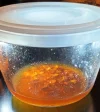
The olibanum in IPM, ready to shelf for a while.
 
View attachment 56808
The olibanum in IPM, ready to shelf for a while.
excellent I'll bet you that's delicious. My projects have been on the back burner as I have been a little more involved in things kind of out of my control than usual - helping my daughter move and my father deal with medical appointments and overnight guests which are challenge at his age etc. Appreciate the updates.
 
excellent I'll bet you that's delicious. My projects have been on the back burner as I have been a little more involved in things kind of out of my control than usual - helping my daughter move and my father deal with medical appointments and overnight guests which are challenge at his age etc. Appreciate the updates.
Would have been a more elegant procedure to let it rest in the ethanol prior to transferring to IPM, at least that feels more elegant to me.
Bit of a rollercoaster for the poor material this way.
Had it be a blind test i would have thought it is a frankincense-myrrh blend. It has gained these dark myrrh like notes at the lower end while keeping the citrus fresh at the top.
Keen to revisit after it has been sitting on the shelf for a while.

Your family is blessed with such a caring son/father🙏
 
Last edited:
Swiped some fractionated Vetiver this evening (Fraterworks NZ) Thats an odd experience. Not so much that it appears very smooth, with the rough edges removed that's to be expected. But it has a intriguing water note that i can't pickup from complete oils. Not petrichor or rain, but it simply smells wet. Definitely more swiping&sniffing ahead to try figure out how&why 💧

Bought this to aid in my struggle with La Verde 🙂 However, after sniffing that dry distilled Frankincense, it kind of dawned to me that maybe the Frereana is to lightweight in that formula. Sitting between a sharp top and rough base, it has quite a bit of work to do. With the wider spectrum of a Frank extract, it may reach further into the top and base registers. Trial incoming 🙂

Oh, and i sourced ~3ml of vintage Guerlain Vetiver with the topnotes intact, for study purposes. Will toss that spoiled bit in the chemical waste bin then 👋
 
Last edited:
Swiped some fractionated Vetiver this evening (Fraterworks NZ) Thats an odd experience. Not so much that it appears very smooth, with the rough edges removed that's to be expected. But it has a intriguing water note that i can't pickup from complete oils. Not petrichor or rain, but it simply smells wet. Definitely more swiping&sniffing ahead to try figure out how&why 💧

Bought this to aid in my struggle with La Verde 🙂 However, after sniffing that dry distilled Frankincense, it kind of dawned to me that maybe the Frereana is to lightweight in that formula. Sitting between a sharp top and rough base, it has quite a bit of work to do. With the wider spectrum of a Frank extract, it may reach further into the top and base registers. Trial incoming 🙂

Oh, and i sourced ~3ml of vintage Guerlain Vetiver with the topnotes intact, for study purposes. Will toss that spoiled bit in the chemical waste bin then 👋
I know what you're talking about as far as that wet note goes. There is a brand of Japanese incense that talks about that wet attribute as a kind of signature of their line, trying to remember the name… Fu-un Aloeswood or Fu-in (something like that) for the name of the sticks themselves, unfortunately the name of the brand eludes me at the moment. First time I smelled it my thought was that it had haitian vetiver oil or oil fractions in it.
 
I know what you're talking about as far as that wet note goes. There is a brand of Japanese incense that talks about that wet attribute as a kind of signature of their line, trying to remember the name… Fu-un Aloeswood or Fu-in (something like that) for the name of the sticks themselves, unfortunately the name of the brand eludes me at the moment. First time I smelled it my thought was that it had haitian vetiver oil or oil fractions in it.
To get such wet note from a burning incense must be an even more remarkable experience. I tend to gravitate towards India and Java vetivers. I need to study the other bottles more, for i have not noticed it before.
Always a trade-off between what you need to swipe for study and want to swipe for joy..
I think the fractionated is Haïti but would have to verify, am not sure - reading more than i can remember 🙂
 
To get such wet note from a burning incense must be an even more remarkable experience. I tend to gravitate towards India and Java vetivers. I need to study the other bottles more, for i have not noticed it before.
Always a trade-off between what you need to swipe for study and want to swipe for joy..
I think the fractionated is Haïti but would have to verify, am not sure - reading more than i can remember 🙂
if you have a neutral smelling incense stick you can try smearing a little bit of vetiver oil on it and burning. Some oils will really add a fantastic character to sticks if they are pure. Patchouli can be very interesting in particular
 
Top