
So that’s a pretty commonly used “smoke infusion” method that a few of the perfumers in our community use. Russian Adam and Taha Syed does this a lot with their fragrances and it works nicely. You’ll need to use DPG though as it seems to be the best carrier. It’s pretty cool that you’ve created something on your own though as I think this method might be a bit different from what they use although I do know that there’s products you can buy now that are for this very purpose.

A lot of Michelin star chefs will use this method for capturing essences for their food. There’s an episode on Chef’s Table where a dessert chef does this with soil and smoke for a dessert that won him a Michelin star. It’s pretty incredible what you can do with this kind of tech and im
Not sure why more perfumers don’t utilize this extraction method. I’m excited to see what you do with this. It’s truly artisan perfumery at its finest.

Update us as you make this device I’d love to see it in action.
All right now we’re getting to the source of where this super smoky oud is coming from! I’ve been asking about this for a while here, but not really getting any new answers so I decided to just tinker. Awesome that people are doing this and thanks for sharing information. I wonder if the products are the result of that patent I saw?

As a very minor consumer of the stuff, my opinion may be irrelevant, but I would suggest any oil made this way should be labeled as such. You can’t call essential oil imbued with captured smoke a pure essential oil.
 
Last edited:
All right now we’re getting to the source of where this super smoky oud is coming from! I’ve been asking about this for a while here, but not really getting any new answers so I decided to just tinker. Awesome that people are doing this and thanks for sharing information. I wonder if the products are the result of that patent I saw?

As a very minor consumer of the stuff, my opinion may be irrelevant, but I would suggest any oil made this way should be labeled as such. You can’t call essential oil imbued with captured smoke a pure essential oil.
Oh I should’ve clarified they make their perfumes with this method. Whenever Russian Adam or Taha or even Ahmed with Elixir say they have “infused Agarwood smoke from sinking grade wood/Kinam/kyara” this is the method they use. I don’t believe they do it with the oils because all you have to with oil is to overheat the pot and scorch the wood to get a destructive distillation process that results in a super Smokey oil.

But I do believe from the snippets of videos I’ve seen the method you’re describing is what they use for perfume purposes and I’ve seen some people on Basenotes use that method to capture smoke note in DPG and then dilute the Smokey DPG in ethanol and it works really well for perfumery.
 
I figured they would be labeled - seems like a necessity. I’m planning to do this to make attars, sandalwood base. For my own use, I likely would use the biotech santalol due to its price and suitability as a receiver of scent. I am not fond of oud/sandalwood blends though so for that one I may bubble into a bottle of ethanol. I wonder why the DPG step and not just direct infusion of alcohol?
 
I figured they would be labeled - seems like a necessity. I’m planning to do this to make attars, sandalwood base. For my own use, I likely would use the biotech santalol due to its price and suitability as a receiver of scent. I am not fond of oud/sandalwood blends though so for that one I may bubble into a bottle of ethanol. I wonder why the DPG step and not just direct infusion of alcohol?
DPG is viscous and completely odorless so it works better to capture the aroma of smoke verse just ethanol.
 
Absolutely. to start since I am making ethanol-based perfumes and don’t use DPG for any other reason I will stick with ethanol.

Also, I was thinking that the lower the viscosity of the liquid the better. I was 50-50 on alcohol versus santaol isolate but I actually chose alcohol because if it’s lower viscosity. Not from experience just a hypothesis that this would be more easy to infuse.

If you’re familiar with those air diffuser stones that are used in fish tanks, I would hope to use one of those to create millions of tiny simultaneous bubbles instead of a larger bubble stream. I think the viscous liquid would effectively clog those pores and the air would end up channeling through some path of least resistance, and not break up into millions of tiny champagne type bubbles.

I think the unbelievably high surface area of the tiny bubbles might make up for the fact that the bubbles travel more quickly through the medium
 
Can I ask "how" do you use your ceramic heater for resin? I have one but rarely use it for resin as I seem to always need to crank the heat up really high to get anything to melt and even then it takes a while. Is this normal? What's an average temp for melting frankincense? It shouldn't need to be so hot should it?
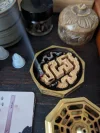
I have two separate heaters just for resins. One is a glazed ceramic one that I use for monkoh type study; close range low temp and then gradual increases, just to see the different subtleties unfold. The other one I use is the exact same one you've shown in the photo, I bought a few of them on aliexpress for very cheap. I use a thinner metal plate than the one that is shipped with the model you are showing, it was from a now defunct bakhoor heater I bought in India. I feel that a thinner plate works better than the one provided in the kit that was shipped with the heater. That smaller plate is too thick in my opinion.

As for the heater that you and both share, I often find myself using it at 350 for enjoying blends or individual resins.
That's the temperature I set at bedtime for a few hours and drift off.
Of course, each resin will perform differently under different temperatures, and sometimes minor adjustments have to be made to get the desired effect out of each resin. When things are too hot they become bitter, just like when green tea is scalded with hot water. Some resins don't melt either. Often sacras and hojaris will just leave a shrunken or dehydrated mass at the end of the session, but if you really want to liquify them, use charcoal with a piece of tin foil and you might get a soup.

Many of these resins will release their goods slowly over time at a slightly lower temperature. I guess it depends how close you're gonna be to the heater, or if you're trying to fumigate your place. I'd suggest experimenting with temperatures around 200-220 first and see. Likely these heaters are not always are not accurate to the temperature shown, so that's based on mine. It's great to use a heater rather than coals. I find almost every resin I have is more enjoyable on the heater rather than by smoke at home. It's nice to sit outside with the coals and resin though. Love that experience.
 
I tried Doc's Processed Philipines stick earlier today. I think I hyped this one up in my mind before I got it to be a particular profile found in the islands. I was expecting something far more bold and dank, although he never specified what type it was. Perhaps something was lost in the processing of the wood to really make it stand out, or perhaps I should wait until there is a sinking grade stick available.
 
I have two separate heaters just for resins. One is a glazed ceramic one that I use for monkoh type study; close range low temp and then gradual increases, just to see the different subtleties unfold. The other one I use is the exact same one you've shown in the photo, I bought a few of them on aliexpress for very cheap. I use a thinner metal plate than the one that is shipped with the model you are showing, it was from a now defunct bakhoor heater I bought in India. I feel that a thinner plate works better than the one provided in the kit that was shipped with the heater. That smaller plate is too thick in my opinion.

As for the heater that you and both share, I often find myself using it at 350 for enjoying blends or individual resins.
That's the temperature I set at bedtime for a few hours and drift off.
Of course, each resin will perform differently under different temperatures, and sometimes minor adjustments have to be made to get the desired effect out of each resin. When things are too hot they become bitter, just like when green tea is scalded with hot water. Some resins don't melt either. Often sacras and hojaris will just leave a shrunken or dehydrated mass at the end of the session, but if you really want to liquify them, use charcoal with a piece of tin foil and you might get a soup.

Many of these resins will release their goods slowly over time at a slightly lower temperature. I guess it depends how close you're gonna be to the heater, or if you're trying to fumigate your place. I'd suggest experimenting with temperatures around 200-220 first and see. Likely these heaters are not always are not accurate to the temperature shown, so that's based on mine. It's great to use a heater rather than coals. I find almost every resin I have is more enjoyable on the heater rather than by smoke at home. It's nice to sit outside with the coals and resin though. Love that experience.
Thanks for your reply, Yes I think I need a YouYuan or something just for woods. Great that you have the same heater to make your advice totally relevant. I have also come to the same conclusion that the real temp and that shown are potentially different. I'll try a different container for the resin and see how I go. Thanks again.
 
I'm currently burning straight up Western Australian sandalwood powder from New Mountain. It's soooo smmooothhh.
 

Attachments

  • [Ouddict.com] Incense of the Day
    PXL_20231206_065810802.MP.webp
    131 KB · Views: 62
Have you received a receipt of purchase and/or tracking? Probably still a bit too soon for it to have arrived. I'd get onto them though with your order number if you haven't already.
 
A different Jayapura from MTN Incense than the last stick I burned from him. This one is sinking grade with a monkoh profile. The stick burns at low, gentle heat, "soft florals, intoxicating". The smoke quantity is ideal. The texture and aroma of the smoke are both resplendent. Big and bold, at the same time refined and composed.

Bliss; paired with a savory Taiwanese Dong Ding oolong.
 
Back
Top