You got me there Al Shareef Oudh 🙂 To be a distiller would be awesome. Agarwood and essential oils in general. But not anytime soon I think. Setting up a distillery requires quite a lot of cash. 😛


There are quite a number of beneficial plants in my country readily available, but it's hard to find local producers of oils, if there are even any to begin with. So who knows...If you can't find'em..make your own? Haha.


Atleast, I won't be easily duped if I have some knowledge about distillation. Too many sellers of essential oils (agarwood and others), and it is an industry quite heavily threatened by adulteration I heard. It's hard to filter them one by one if I don't know anything.
 
Hello all

let's go scientific :

https://www.jstor.org/stable/23617103?seq=1#page_scan_tab_contents

"The aims of this study were to investigate vaporisation temperature of agarwood oil, determine enlargement of wood pore size, analyse chemical components in soaking solvents and examine the chemical composition of agarwood oil extracted from soaked and unsoaked agarwood. Agarwood chips were soaked in two different acids, namely, sulphuric and lactic acids for 168 hours at room temperature (25 °C). Effects of soaking were determined using thermogravimetric analysis (TGA), scanning electron microscope (SEM) and gas chromatography-mass spectrum analysis. With regard to TGA curve, a small portion of weight loss was observed between 110 and 200 °C for agarwood soaked in lactic acid. SEM micrograph showed that the lactic acid-soaked agarwood demonstrated larger pore size. High quality agarwood oil was obtained from soaked agarwood. In conclusion, agarwood soaked in lactic acid with concentration of 0.1 M had the potential to reduce the vaporisation temperature of agarwood oil and enlarge the pore size of wood, hence, improving the yield and quality of agarwood oil.

Matlamat kajian ini adalah untuk menyiasat suhu pengewapan minyak gaharu, menentukan pembesaran saiz liang kayu, menganalisis komponen kimia yang larut dalam pelarut rendaman dan mengkaji komposisi kimia minyak gaharu yang diekstrak daripada kayu yang direndam dan yang tidak direndam dalam pelarut. Serpihan kayu gaharu direndam dalam dua jenis asid iaitu asid sulfurik dan asid laktik pada suhu bilik (25 °C) selama 168 jam. Kesan rendaman ditentukan menggunakan analisis termogravimetrik (TGA), mikroskop elektron pengimbas (SEM) dan analisis kromatografi gas spektrum jisim. Daripada graf TGA, didapati sebahagian kecil daripada kehilangan berat diperhatikan pada suhu antara 110 °C hingga 200 °C bagi gaharu yang direndam dalam asid laktik. Mikrograf SEM menunjukkan bahawa gaharu yang direndam dalam asid laktik menunjukkan saiz liang yang lebih besar. Minyak gaharu berkualiti tinggi dapat diperoleh daripada gaharu yang direndam. Kesimpulannya, gaharu yang direndam dalam asid laktik berkepekatan 0.1M mempunyai potensi untuk mengurangkan suhu pengewapan minyak gaharu dan membesarkan saiz liang kayu. Justeru, hasil dan kualiti minyak gaharu dapat dipertingkatkan."


I think I have the whole journal on this, practice it but didn't work, de not every wood can be soaked.

Facinating insight into technique, thank you.

It's also worth noting that not all acids are detremental to organic compounds, prime examples being Ascorbic and Alpha-Lipoic.
 
Last edited:
Also
Facinating insight into technique, thank you.

It's also worth noting that not all acids are detremental to organic compounds, prime examples being Ascorbic and Alapha-Lipoic.
Also lactic acids isn't dangerous for the oil too, someone had tried this up too. But I heard it's not prevailing in yield.
 
Can anyone explained about the oud oils with a very black color, most oils as I have see are the usual red and dark red. Is it aging for a long time will turn them black? I also have see fresh distillation of very good oil to be very black but also from what I have experience most of the really bad oils like most oils from Aloes of Ish and Ham Firil, they all have the same very black color and are all horrible oils, this oils not matter what origin all same viscosity and black color, I did have few cheap ones from both in the beginning of my oud journey and they have been throw in the garbage after only few tries.

So I will be interesting to know the reason behind good oud oil that is coming black from the pots and not the usual reddish color. And if aging also will turn bright red or yellow oil to a black over the years.

Thank you.
 
Partially agree but, without hurting the tree, there is no defense mechanism produced hence no agarwood. which is form around the wound
[Ouddict.com] Oud Distillation


Leaving it for nature to do the work is possible, it is a matter of time, possibly 10 years plus given the healthy tree is 8 year old.
For commercially point of view, this process will take too long and there is little return for farmer. As mostly, the land was owed by the landlord unless agreed to, rent is paid monthly 🙂.
The below is a healthy Aquilaria tree , by chance discovered in a private land and we decided to give it some juice

[Ouddict.com] Oud Distillation


After 5 months

[Ouddict.com] Oud Distillation
 
@RobertOne

Friend I don't think people will use Vitamin C to soak Oudh 🙂

@agarwoodindonesia

🙂 how is lactic acid a practical applicator in soaking?

by the way @Russian Adam has been very quiet lately, I hope he is well.

No no, I did not mean to imply that these acids should be used with the maceration / soaking process, but rather not all acids are harmful to organic compounds.

On the other hand... why not?

Has any comprehensive experiment been run comparing quality and yield with the addition of different acids? Perhaps this would be worthwhile with some low grade agarwood dust to settle the matter once and for all.

With Aquilaria becoming rather thin on the ground surely it would be the responsible thing to do. Certainly all data gained from this experiment should also be propigated to all artisans, to not do so would be criminally wasteful.
 
@5MeO @Oudamberlove

A couple of days ago post #524 from the thread below on Gaharu was sent to me by a number of different people requesting me to comment on it https://gaharu.com/showthread.php?406-SOTD&p=5400&viewfull=1#post5400

One point that I have made many times before, and for reminders sake I make again is that we are all human and humans are limited beings who constantly make mistakes. For those of us who follow the Islamic tradition there is a famous saying of the Holy Prophet peace be upon him transmitted by Al- Tirmidhi that mentions “Every son of Adam sins, and the best of those who sin are those who repent.” Humans make mistakes due to our limited nature; having a bad day, slip of judgement, weakness in our senses or an array of other things can cause us to misjudge decisions in life let alone assessing someone else’s oil purely based on human conviction.

Our world-famous Al Shareef II Oudh Oil that was distilled by us in the year 2012 in Kelantan Malaysia was distilled from Wild Malaysian Oudh trees - not Thai and most definitely not relocated saplings. The wood was selected by myself as with all our distillations and cleaned, dried and pulverised. Our aim? To bring forth to the consumer the defying scent that haunts the Oudh hunters -"the scent of the tree". The scent of the very tree that has been fighting off fungal attacks for hundreds of years - the scent that represents the spirit of the tree.

Dr W.S (Kyarazen) describes the wood we used in this oil; “ In my collection of fragrant woods, there is a precious block of north malaysian heartwood that I cherish tremendously, it is one of the very few woods, when heated, reminds me of oud. This wood probably came from a huge wild tree over a century old, as the heart of the tree starts to rot and crumble, together with the compaction with the tree’s growth, there is a detectable hint of “barnyard”, notes that are given off when wood fibres of the agarwood tree ferment, in this case, not in pots or plastic tubs, but in the heart of the living tree. When I found out that Alshareef II was made of north malaysian woods, I knew it was definitely from this type and class of material. The raw wood is not easy to come by, not to even think of putting it into a distillation pot! This is not your typical “malaysian oud”, instead the scent of the very heart of this oud, reminds me of the core of the classical and famed early generation Kalakassi 80 from ASAQ.” Ref https://www.kyarazen.com/alshareef-ii-journey-to-the-heart-of-oud/#

The techniques that we at Al Shareef Oudh have in our manuals, is not a collation of the experience of 5-10 years of a self-taught individual it is the collation of the knowledge, experience and experiments of many generations of artists. I was born into a household where oudh was part of daily life, part of business, and an integral part of honouring of our guests, my sensory data stretches generations not 10 years. We employ those experiences and our innovations on a daily basis to bring unique art work in the form of oils to our discerning clients. As such I am not going to be offended if a person with 2, 5 or 10 years untrained experience gets struck between the eye with one of our oils and mistook its origin.

After the wood was pulverised, it was soaked at room temperature in burnay clay pots (not blue plastic drums, in fact we don’t have any blue drums at any of our facilities) for two weeks (not 4 months, not six months - not any months) and on the beginning of the third week the cooking began. When wood of such high quality oil and resin content goes into the pot, one of the important considerations a distiller has in mind is to ensure that they run an efficient distillation life cycle. It is for this purpose that we chose 2 weeks of soaking, when wood is soaked for this length of time the Agarwood Oil Yield increases as a result of changes in cell morphology, however if the soaking is extended to 21+ days the yield drops due to the acids that are introduced into the matter as part of the fermentation process. This is a bit of information that will be helpful to other vendors as well, especially when dealing with high quality woods like that which went into Al Shareef II. Our experiences were confirmed by research conducted by some friends at the University of Technology in Shah Alam, and published findings by Veronica Alexander Jok et al - these are some of the considerations that go into why we do things the way we do.

The old age of the tree, the decay, the decomposition and fibre compaction over time had a natural sweet barn imbedded in the fibres of this wood. That sweet barn-cheese note was present in the decaying tree even as we fell it. We have samples of the wood that went into this pot, as we do with others, when the wood is slightly moistened many of the notes that is present in Al Shareef II become apparent.

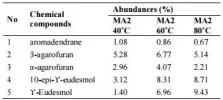
We cooked this oil at variable low temperatures ranging from 40 C – 80 C. This is why we mentioned in our product launch explanation that it is an active oil (https://www.alshareefoudh.com/product-detail.php?product_id=11) distilled at low heat to preserve its nutrients. Within the essential oil philosophy, the lower the temperature at which the oil is cooked the more of the natural plants nutrients make it to the final oil. The technique of varying low temperatures for cooking agarwood is proven by our research to be most effective with Malaysian woods, and because our aim was to retain the raw scent profile of the decaying tree this worked best for us. The Table below produced by Nurlaila Ismail et al also illustrates the data collated from a sample of Malaysian wood cooked at 40 60 80 C and the abundance in percentage of the 5 most important compounds that contribute towards the oudh properties ;


As you can see the varying temperature allows an increase in the different chemical compounds, therefore varying the temperature will extract the compounds from the wood, that otherwise would not be possible under a set temperature. For further reading please refer to ANALYSIS OF HIGH QUALITY AGARWOOD OIL CHEMICAL COMPOUNDS BY MEANS OF SPME/GC-MS AND Z-SCORE TECHNIQUE

Our experience and research together with third party research establishes that with the techniques at our disposal we can draw a wide range of scents from Malaysian woods. Malaysian woods being one of the most complete oudh wood can in the hands of the right person produce a myriad of scent profiles.

Once the oil was cooked, we utilised our innovative method of curing the oil which is very different to any other curing method utilise by others. The general process with other distillers for curing is aerating the oil for a few days, then possibly lamping it or sun lighting for a few days. Our method is different. For example one of our techniques is we cure our oils in water, the bottles of oil have a trap placed on the top and then the bottles are placed in our curing chambers, through this method we can retain the profiles we want and ‘evaporate’ those that we dislike. We can also control how much moisture remains in the oil and many other fine tunings can happen in this phase.

I did not respond to this post immediately, though many friends and clients would have liked me to do so. I wanted the dust storm to settle so it doesn’t become a slinging match of ‘he said’ and ‘I said’. I afford my brother the benefit of the doubt and I have shared the facts regarding the what, how and why of Al Shareef II, and whilst we are talking about Al Shareef II, the complexity of this oil has perplexed many and it is for this reason many clients who have this oil hold it dearly.
It is the oil worn by Shuyukh of the Al Otaiba clan in Dawadmi, it is the oil of choice for the Shaykh of Dowsary, in Wadi Al Dawaasir and many other statesmen in the gulf whom I won’t name here. These are people who have enjoyed Oudh in their tradition for hundreds of years and can easily discern if something isn’t right.

In Conclusion as humans the experiences we hold impact how we perceive our surroundings, similarly the experiences any individual or vendor has with regards to oudh oils and the possibilities with them impacts how they view oils and artistic expressions outside of their individual experience, it is like the experience of a tadpole in a small backyard pond, compared to that of a dolphin in the ocean. What is a daily occurrence in the life of the dolphin is not imaginable to the tadpole.

I would also like to make another correction that was posted on Gaharu (link) post #128 regarding another of our products, Al Shareef Oudh has only ever released one Al Ghaliyah not two.

I will post regarding the Chinese Sinensis, and Sinensis from other regions later, in that post I will also include details on how the Chinese distil the Sinensis compared to somewhere like Laos. As per our approach this will be research data, not someone’s words, Sinensis has most similarities to A.agallocha and A.Malaccensis, and not as many commonalities with A.Crassna. There are many research findings on Chinese Sinensis and one that discusses this topic in detail is by Wen-Li Mei et al.

I hope the moderators don't get upset but just to close off this response we would like to announce to all you good people a special promotion on Al Shareef II, with the promotion code ItsNotAThai, we will refund you $60 USD back. Offer until 6th of Jan 2017.


Watch this space.

 

Attachments

  • [Ouddict.com] Oud Distillation
    Table.webp
    9.9 KB · Views: 425
Last edited:
Thanks for this detailed post. I am not surprised that someone (even someone with a good amount of experience) would have trouble correctly identifying the species and origin of an oil. I recall reading that identification of agarwood is quite challenging without genetic analysis. I am not sure of course how much the nose can really pick up.

I have to say I'm surprised how totally far off the assessment was in that post you reference, and the large amount of confidence behind it... makes you wonder!

When reading posts about the effects of soaking time, container material, water type, etc. in light of how far off this assessment is - makes it hard to know what to believe. I know this may be a controversial thing to bring up, but as a consumer I have to at least mention it. I mean, if one can mistake a wild Malaysian short soak oil for a cultivated Thai 6 month soak... how can one possibly assess the effects of other more subtle variables? I am sure this will offend some, but it seems like it needs to be addressed.
 
Last edited:
Great post Alshareef. I have to say that I did wonder after that Gaharu post, but your clarification has put this to rest.

Makes you wonder what other mistaken assumptions are made by 'experts' and believed by customers who don't know any better.

I think that this demonstrates that a scientific approach to discerning the origin and veracity of vendor claims is a better way forward.
 
Sensory Data is a very personal thing, our olfactory experience is tied-into how we perceive a particular scent ( and there is a myriad of them in Oud ), which is further influenced by the environment, our memory/scent library, what we choose to identify at that moment of assessment, the current state of our olfactory capabilities ( other things you have been smelling lately, and olfactory fatigues ). So if someone tells me they smell dark purple grape candy in Oud Yusuf, I can't deny them their experience. It just so happens that when I take some good whiffs of Arabian Oud's Kalemat Wood Oil, then sniff a swipe of Oud Yusuf, I do get that dark purple grape candy note😱
 
For me ASII smell everything but thai...old cambodi yes...a bit of barn hindi yes...very complexe oil yes.

But I have only two years of oud sensory data 🙄
 
Last edited:
I smell ASII & I don't think is Thai at all the subject was full of miracles like when I smell oud I know how much soaked and if wild or plantations & how old the tree or not pure.

we need to close GCMS lab's! That's really ridiculous...
 
Al Shareef 2 to me smells anything but Thai according to my personal Oud brain library. I could think its maybe a Hindi, slightly Chinese and i can deffo pick up the Malaysian character. I don't think anyone can claim to smell an oil and think they can tell everything about the DNA, however i'm sure with experienced users some aspects of the oils can be picked out i.e region wild/cultivated etc
 
I don't have the chance to smell ASII so I cannot give my personal point of view but even if in this case the question is not about the purity GCMS testing is something that we have to think About seriously in the future.
I remembered a very hot discussion between Taherg and a well known seller on the other oud forum.
By the way still waiting for KZ85 and Sultani report!
 
@firdaous I have the sultani report 100% and many ppl see it here (Faisal , Faheem , habz786) but why I post it ? I won't share it because this miracles man always attack other vendors and think he is the only who own pure ouds...
 
Top