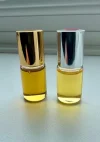
Scored two tola's of local Indonesian sandalwood yesterday for $90 USD. Very light in colour and quite thin in viscosity but it packs a punch in the santalol department. Very creamy and quite deep wood notes. Nothing citrusy at all. Unfortunately I did not think to ask at the time when it was distilled. View attachment 54554This will be perfect for the maceration I have in mind.
Now I wanna go on vacation 😂😍
 
Scored two tola's of local Indonesian sandalwood yesterday for $90 USD. Very light in colour and quite thin in viscosity but it packs a punch in the santalol department. Very creamy and quite deep wood notes. Nothing citrusy at all. Unfortunately I did not think to ask at the time when it was distilled. View attachment 54554This will be perfect for the maceration I have in mind.
Very nice picture! I don’t know why, but the bottles are looking refreshing 😂
 
Picked up two Sandalwood oils when I was in Taiwan.

The one on the left is 10 year-old Mysore. Profile is rich, spicy, lemon curd and ghee…no white-woody notes at all. The seller let me sniff it straight from the stainless steel wholesale container, which was quite something 🤤. I really should have bought more of this.

The one on the right was a freebie from a different shop, described as Laoshan (老山) sandal. I assumed it was Chinese origin, but a Google search indicates that this term is also used for Indian sandalwood, so I’m not sure. In any case, this seems to be from a much lighter fraction (if it is actually santalum). Profile is cool, floral, aromatic, white-woody.

IMG_1174.webp
 
freebie from a different shop, described as Laoshan (老山) sandal.
Prob didn't happen here, but my experience with 'random' old mountain/Laoshan was the one i got, it smelled fineish, lighter color, but a quick waterdrop test showed that it was diluted (likely DPG). The oil floated, the DPG fell into solution with the water. Unfortunate, but thankfully a cheap lesson. I did extract what sandalwood I could through extraction, but it'll likely never be the same, good for sample 'stand in' blending.

Not sure how prevalent that practice is, but now i check, worth a drop for an easy test that doesnt take long or any tools. (since if its real, you can still use the drop anyway). Laoshan can mean india, but generally i assume its just like indonesian plantation or something.
 
Last edited:
Prob didn't happen here, but my experience with 'random' old mountain/Laoshan was the one i got, it smelled fineish, lighter color, but a quick waterdrop test showed that it was diluted (likely DPG). The oil floated, the DPG fell into solution with the water. Unfortunate, but thankfully a cheap lesson. I did extract what sandalwood I could through extraction, but it'll likely never be the same, good for sample 'stand in' blending.

Not sure how prevalent that practice is, but now i check, worth a drop for an easy test that doesnt take long or any tools. (since if its real, you can still use the drop anyway). Laoshan can mean india, but generally i assume its just like indonesian plantation or something.
What's the method?
 
What's the method?
to test or extract? to test, easiest way i've found to tell if an EO is diluted with DPG is to take a small bit of water, drop in a drop or two of your EO, swirl. DPG is water soluable, the oil is not. Take a dropper and extract some of the water below the floating oil.

dry that water on a slide, plate, or other hard surface (fan, light heat, sunshine, whatever). once the water is dry, if its oily, there was DPG or other water miscible content as a dilutant. pure sandalwood oil cleanly separates, so the water when dried would just be.. nothing, possibly trace calicium or dust if your water was extra hard, but not greasy.

to extract, (prob better ways here too), but what i did was dump my little container in water, swirl, thne put it in a separating funnel to remove the water leaving the oil behind, then use something like dried magnesium sulfate (heated epsom salt) to absorb the water, then filter to remove it, so now theres no tiny bits of water in your oil. better than nothing, but its not super awesome and likely some character lost in the extraction i assume.

 
to test or extract? to test, easiest way i've found to tell if an EO is diluted with DPG is to take a small bit of water, drop in a drop or two of your EO, swirl. DPG is water soluable, the oil is not. Take a dropper and extract some of the water below the floating oil.

dry that water on a slide, plate, or other hard surface (fan, light heat, sunshine, whatever). once the water is dry, if its oily, there was DPG or other water miscible content as a dilutant. pure sandalwood oil cleanly separates, so the water when dried would just be.. nothing, possibly trace calicium or dust if your water was extra hard, but not greasy.

to extract, (prob better ways here too), but what i did was dump my little container in water, swirl, thne put it in a separating funnel to remove the water leaving the oil behind, then use something like dried magnesium sulfate (heated epsom salt) to absorb the water, then filter to remove it, so now theres no tiny bits of water in your oil. better than nothing, but its not super awesome and likely some character lost in the extraction i assume.

To test. Appreciate the explanation.👍
 
I was looking for some 'ok' sandalwood mostly as a base for blending as a standin without breaking the bank for blends I'm working on and came across an ebay seller. Proper documentation-ish (though its likely indonesian), the kicker that made it interesting is, he's had it since 2020, but didn't think to price that in as any sort of benefit. So, new indo priced, 6 years of age on it. Not best thing ever or mysore grade, but, quite thrilled with it, will probably order some more. Creamy enough, a little bit of age, not so dear I'll cry over failed tests. Priced inline with bulkaroma sandalwood, but a better quality and no import taxes.
 
Last edited:
Enjoying this sample of "Mysore 2025" from @AlHind Oud

If I recall correctly, this was not distilled by Anas and the aroma reflects that, it has a different signature than his own distillations.

I don't know a lot about this oil so I can only comment on the aroma which fits the bill pretty much perfectly for a quality contemporary distillation of Indian sandalwood. A nice enough aroma to be worn straight, would also fit nicely into formulas requiring a traditional sandalwood oil. At the moment I'm enjoying the nice fine dry clean woodiness of the mids. Good stuff.

IMG_8759.webp
 
Enjoying this sample of "Mysore 2025" from @AlHind Oud

If I recall correctly, this was not distilled by Anas and the aroma reflects that, it has a different signature than his own distillations.

I don't know a lot about this oil so I can only comment on the aroma which fits the bill pretty much perfectly for a quality contemporary distillation of Indian sandalwood. A nice enough aroma to be worn straight, would also fit nicely into formulas requiring a traditional sandalwood oil. At the moment I'm enjoying the nice fine dry clean woodiness of the mids. Good stuff.

View attachment 54772
You’re right, this will be an ideal specimen for blending and perfumery. I’ve been experimenting with it and found it to be quite intriguing. By the way, this is steam-distilled sandalwood oil, while mine is hydro-distilled.
 
Scored two tola's of local Indonesian sandalwood yesterday for $90 USD. Very light in colour and quite thin in viscosity but it packs a punch in the santalol department. Very creamy and quite deep wood notes. Nothing citrusy at all. Unfortunately I did not think to ask at the time when it was distilled. View attachment 54554This will be perfect for the maceration I have in mind.
Is Indonesian Sandalwood also the Santalum Album species?

I tried some Santalum Album oil from Ceylon and found it to be very pleasing.
However Mysore Santalum Album remains my favorite, but costly.

Australian Santalum Spicatum I didn't like much, has a green spicy note which I associate with betel leaves.

I see terroir differences within the same species exist in Sandalwood as well, although not as pronounced as in Agarwood.
 
You’re right, this will be an ideal specimen for blending and perfumery. I’ve been experimenting with it and found it to be quite intriguing. By the way, this is steam-distilled sandalwood oil, while mine is hydro-distilled.
The oil yield in steam distillation must be far less than in Hydro distillation right? Just curious.

Could you please highlight some key differences in the aroma profile and texture or the oil?
 
Is Indonesian Sandalwood also the Santalum Album species?

I tried some Santalum Album oil from Ceylon and found it to be very pleasing.
However Mysore Santalum Album remains my favorite, but costly.

Australian Santalum Spicatum I didn't like much, has a green spicy note which I associate with betel leaves.

I see terroir differences within the same species exist in Sandalwood as well, although not as pronounced as in Agarwood.
Indonesian is Santalum album in my experience. Most typical grades have a distinctive mineral earthy terroir, I actually love that because some of the first sandalwood I smelled was Indonesian. The small batch artisanal oils distilled strictly from heartwood I have smelled (olefaktory and @AlHind Oud ) do not have that mineral terroir, and are more similar to fine oils from Mysore and Tamil Nadu.

i'm under the impression that the mineral / earthy notes come from distilling sapwood at higher temperatures and pressures - I have some oils extracted strictly from the sapwood and they present a very concentrated version of the aroma, especially the specimen distilled with high-pressure steam.
 
The oil yield in steam distillation must be far less than in Hydro distillation right? Just curious.

Could you please highlight some key differences in the aroma profile and texture or the oil?
i'm under the impression that steam distillation produces a higher yield in a shorter period of time. For hydrodistillation to produce a comparable yield as steam, a much longer distillation time is needed, especially with something like sandalwood which is slower to evaporate and requires more energy to distill then many other materials.
 
i'm under the impression that steam distillation produces a higher yield in a shorter period of time. For hydrodistillation to produce a comparable yield as steam, a much longer distillation time is needed, especially with something like sandalwood which is slower to evaporate and requires more energy to distill then many other materials.
Oh now that you speak of high pressure steam it makes sense and makes me think that the yield from steam distillation might indeed be higher.
Because, hydrodistillation is usually done within controlled temperature ranges especially when focus is on quality of the oil.
 
Indonesian is Santalum album in my experience. Most typical grades have a distinctive mineral earthy terroir, I actually love that because some of the first sandalwood I smelled was Indonesian. The small batch artisanal oils distilled strictly from heartwood I have smelled (olefaktory and @AlHind Oud ) do not have that mineral terroir, and are more similar to fine oils from Mysore and Tamil Nadu.

i'm under the impression that the mineral / earthy notes come from distilling sapwood at higher temperatures and pressures - I have some oils extracted strictly from the sapwood and they present a very concentrated version of the aroma, especially the specimen distilled with high-pressure steam.
I think it's time for me to try some quality Indonesian Sandalwood oils. Sounds really interesting. I would prefer heartwood distillations for sure.
 
Santal Royale oil Ensaroud. This is an atrociously good full throttle sandalwood oil. A beast that does not relent, and at the same time buttery woody smooth musky meaty intoxicating. It deserves the name Royale. lasts for almost 8 hours on skin. Just a tiny dab is enough to get good projection with it. Borderline animalic and if some one says it has musk in it I would believe it. This is a hidden gem. Yes it is pricey I am sure not many people like this price. But if you are getting any other stuff from Ensar ask for a sample of this oil. I am sure you will not think twice about the price after smelling it.
It is a great oil for sleep induction and relaxation.
 
Back
Top